
When it comes to custom non-standard playing cards mistakes, frequent errors include ignoring bleed margins, choosing flimsy stock that fails under repeated shuffling, and skipping physical prototypes before bulk runs. Indie creators also underestimate compliance needs for EU/US markets. WellCards addresses this with a 1,000+ shuffle durability guarantee, included proofs, and prototypes credited back to orders, catching flaws before Kickstarter fulfillment begins.
Why Do Custom Deck Projects Miss The Mark?
Deck projects usually stall at the handoff, not the idea. A designer sketches mechanics, playtests with friends, then finds out the printer can’t match the card stock or timeline anyone assumed. That gap is where custom non-standard playing cards mistakes creep in: skipped prototypes, vague specs, manufacturers who treat an indie deck like a rounding error on their schedule.
Get a Custom Non-Standard Playing Cards Quote from WellCards
Should a creator print a prototype before ordering a full run?
Yes, almost without exception. Many creators begin custom card projects by printing a prototype first. A prototype tests gameplay, checks balance, and gathers feedback before hundreds of decks get committed to production. Skipping this step ranks as the most common misstep among first-time publishers rushing toward a Kickstarter deadline or convention date.
Does the manufacturer’s location actually matter?
It matters more than most creators expect going in. WellCards, a family-owned manufacturer, operates out of Lanxi City, Zhejiang, China, a region built around card production infrastructure. Location shapes lead times, material sourcing, and how smoothly a deck ships to backers scattered across different countries.
Common friction points show up in the same places, project after project:
No prototype run before committing to bulk quantity
Files sent off without a manufacturer reviewing specs first
Assuming every printer offers real design support
Underestimating shipping timelines on overseas production
WellCards provides full OEM/ODM design support. A solo illustrator or a magician self-publishing a custom deck isn’t left solving spec problems alone at 2 a.m. before a print deadline.
What File Prep Mistakes Ruin Your Print Run?
Sloppy file setup wrecks more decks than bad artwork ever does. Dimensions that drift a millimeter off spec throw borders out of alignment across an entire deck. Low-resolution images turn crisp illustrations into blurry mush the moment a press picks them up. These rank among the most common custom non-standard playing cards mistakes indie creators make before a file even reaches production.
Card size matters most. Confirming file dimensions against required specifications, exactly, catches sizing errors before they become 500 misprinted decks sitting in a warehouse. A prototype built for a standard poker size won’t behave the same as a custom tarot-length card or an oversized magician’s gaff. Every non-standard trim size needs its own dimension check, not a copy-paste from a template.
Resolution matters just as much.
Does image resolution really affect card quality that much?
Yes, significantly. Artwork below 300 DPI prints soft, pixelated, and unprofessional, no matter how sharp the design looked on a laptop screen. Kickstarter creators uploading phone photos or web-resolution mockups run this risk constantly. A minimum of 300 DPI keeps linework crisp and small text legible at full card size.
Common file prep failures worth flagging:
Card dimensions that don’t match the manufacturer’s exact specification
Artwork resolution under 300 DPI
Files exported without accounting for a custom shape or trim size
Catching these errors early costs nothing. Catching them after production starts costs an entire run. WellCards builds proofs and physical prototypes into its process, giving illustrators, magicians, and deck publishers one more checkpoint before bulk printing locks in. That step exists because file problems are far cheaper to fix on a screen than on a pallet of finished cards.
How Does Overcrowded Design Hurt Your Deck?
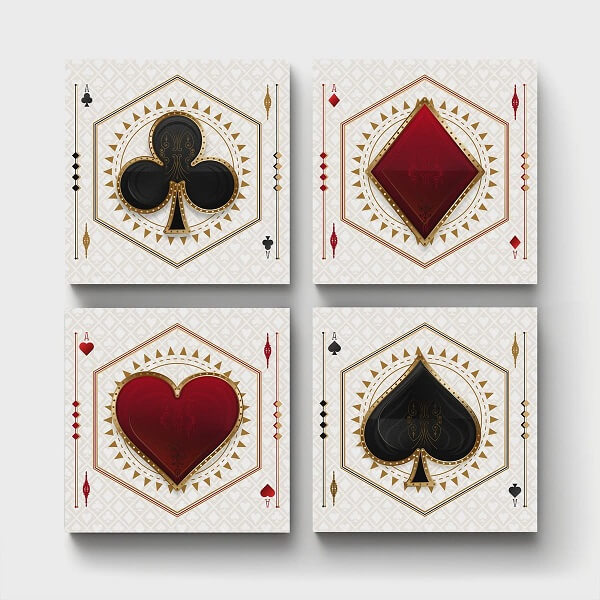
Cluttered card faces confuse players before a single hand gets dealt. Excess text, stacked icons, and crowded borders rank among the most frequent custom non-standard playing cards mistakes indie designers make when moving from screen to print. A deck loses its voice the moment every inch of the card gets filled.
Get a Custom Non-Standard Playing Cards Quote from WellCards
Space works as a design tool, not wasted real estate. When a layout carries too many elements, visual hierarchy disappears entirely. Players’ eyes have nowhere to land. No clear focal point, no obvious rank or suit indicator, no breathing room for artwork. For a Kickstarter deck or a magician’s custom set, that confusion costs credibility fast.
Why Does a Card Need Empty Space?
Empty space guides the eye toward what matters most: rank, suit, or a signature illustration. Without it, every element competes for attention, and none of them win.
Can Distinctive Details Replace Clutter?
Yes. Custom sizing, foil accents, and embossing create standout decks without adding visual noise to the card face. WellCards builds these options into casino-grade custom playing cards produced to precise specifications for gaming, promotional, and retail projects. Proof that distinction comes from craftsmanship, not crowding.
Designers chasing polish should prioritize:
Hierarchy first — rank and suit markers stay dominant, always
Restraint with icons — one strong symbol beats five weak ones
Foil or emboss accents — texture adds prestige without adding text
Negative space — margins protect readability during shuffling and dealing
A deck that breathes reads faster at the table. That clarity, more than any embellishment, keeps players coming back to the game.
Which Manufacturer Mistakes Cost Indie Creators Money?
Manufacturer selection ranks among the costliest custom non-standard playing cards mistakes indie creators make. Price alone rarely tells the full story. Deck volume, quality standards, and service level all shape the true cost of a print run. Creators who skip that comparison often pay twice — once for the cards, again to fix them.
A Kickstarter campaign shipping five hundred decks needs different support than a magician ordering fifty personal decks. Ignoring that distinction leads to a handful of recurring problems:
Choosing the lowest bid without checking material or finishing options
Overlooking certification requirements for cards sold into the EU or US
Assuming factory pricing only exists through resellers or agencies
Does a cheaper manufacturer always cost less in the end?
Not necessarily. A manufacturer holding full EU and US certifications, such as WellCards, lowers compliance risk for creators shipping across borders. Cards lacking that certification get flagged at customs. That delay can push a Kickstarter fulfillment schedule back by weeks, and backers notice.
Why does factory-direct sourcing matter for a small print run?
Working directly with a factory instead of a reseller trims the markup out of the process. WellCards’ factory-direct pricing saves creators 30 to 50 percent compared to going through agencies. That difference covers better card stock, an extra foiling pass, or a second production run entirely.
Indie publishers who treat manufacturer selection as an afterthought tend to repeat these same errors project after project. Matching volume, certification needs, and service level before signing anything solves most of them before they start.
How Can Proofs Prevent Costly Printing Errors?
A physical proof catches problems no screen ever will. Color shifts, stock weight, corner rounding, texture — none of it translates accurately on a monitor. Kickstarter creators who skip this step risk discovering a card feels flimsy or a foil edge looks wrong only after a full print run lands on their doorstep. That mistake is expensive to reverse and slow to fix.
WellCards addresses this by delivering samples within seven days, then completing bulk production in two to four weeks. Publishers get a real deck in hand before committing to volume. Every deck also carries a 1,000-plus shuffle durability guarantee, meaning the sample a designer tests today reflects the wear performance of the final product, not just its appearance.
What Should a Deck Proof Actually Test?
A proof should confirm shuffle feel, card snap, and print registration under real handling conditions. Illustrators and magicians in particular need to check how artwork reads at table distance. Under repeated bridge or riffle shuffles. Material choice matters here too — premium paper or PVC stock options each behave differently under stress. A proof reveals which one suits a given game’s demands.
Does Manufacturer Size Affect Proof Reliability?
Manufacturer scale shapes turnaround and attention to prototype detail. Large, established playing card manufacturers offer predictable capacity. Smaller specialized producers sometimes provide closer, more hands-on review of a single deck’s construction. Creators sourcing prototypes benefit from weighing both paths rather than defaulting to size alone.
Get a Custom Non-Standard Playing Cards Quote from WellCards
Common custom non-standard playing cards mistakes — mismatched stock weight, unverified color, skipped shuffle testing. Trace back to one root cause: rushing past the proof stage. A seven-day sample cycle removes that excuse entirely.
Custom playing card design and printing demands precision at every stage, from initial artwork specifications through final quality inspection. The mistakes outlined—inadequate color management, insufficient bleed allowances, material misselection, and overlooked compliance requirements—represent avoidable pitfalls that compromise both aesthetic and functional outcomes. Manufacturers with established expertise and rigorous quality protocols mitigate these risks through collaborative design consultation, digital proofing, and comprehensive testing. Engaging a production partner equipped with technical depth and manufacturing infrastructure ensures your custom cards meet exacting standards. Deliver the durability and visual impact your application requires.
FAQ
Should a creator print a prototype before ordering a full run?
Yes, almost without exception. A prototype tests gameplay, checks balance, and gathers feedback before hundreds of decks get committed to production, catching flaws early.
What resolution do custom card files need?
Files need a minimum of 300 DPI. Artwork below this threshold prints soft, pixelated, and unprofessional, regardless of how sharp the design appeared on screen.
Does the manufacturer’s location affect a custom deck project?
Yes. WellCards operates out of Lanxi City, Zhejiang, China, a region built around card production infrastructure, which shapes lead times, material sourcing, and shipping to backers.
 English
 Deutsch
 Français
 Polski
 Português do Brasil
 Español
 日本語
日本語 Русский
 العربية
 Italiano
 Nederlands
 Türkçe
 한국어
한국어