
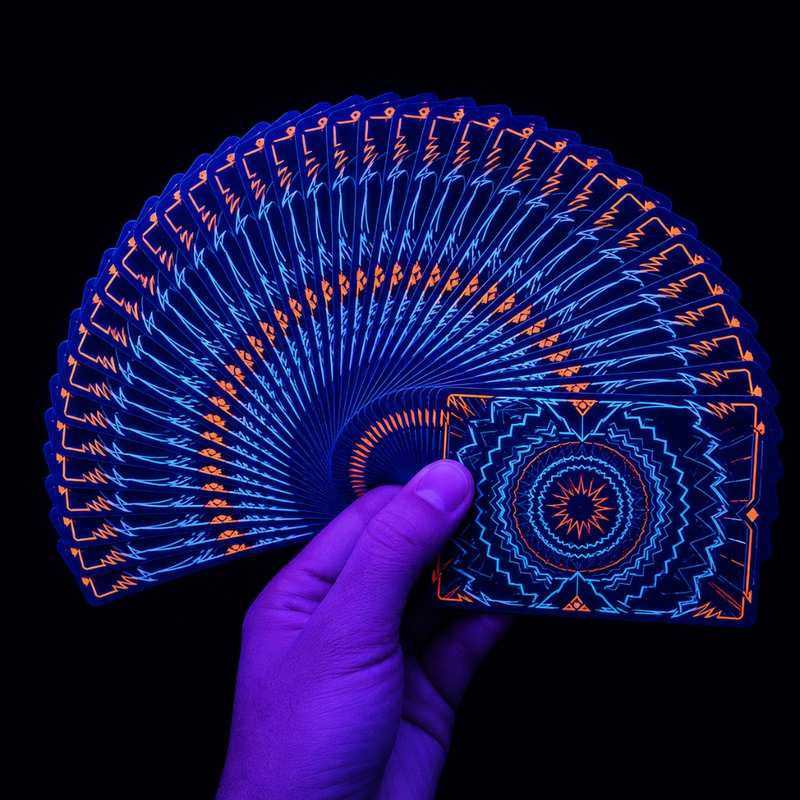
Custom UV playing card MOQs start at 500 decks, with factory-direct pricing saving clients 30–50%. Cost breakdown scales by finish, size, and packaging; digital proofs arrive within 24–48 hours. Physical prototypes are credited back to orders. WellCards guarantees 1,000+ shuffle durability across all custom runs.
Get a Custom UV-Reactive Playing Card Quote from WellCards
What Drives Custom UV Playing Card Costs?
Custom UV playing card costs hinge on material selection, order volume, and finishing complexity. A deck printed on premium paper stock carries a different cost structure than one produced in durable PVC. The specialty playing card printing cost drops sharply when production moves from prototype quantities to bulk runs.
What material choices affect the price of UV-coated cards?
Material selection creates the largest single cost variable. Buyers choose between premium paper stock and PVC substrates. Paper stock delivers a traditional handling feel at a lower base cost. PVC cards withstand moisture and heavy use but increase per-unit expense. The substrate decision locks in the floor price before any finishing work begins.
How does order volume change the per-deck cost?
Volume drives the economics of custom card production. WellCards operates a modern facility in Lanxi, Zhejiang, China, where setup costs amortize across the full production run. A 500-deck order absorbs the same plate and calibration expense as a 50,000-deck order. Larger quantities distribute those fixed costs, reducing the per-deck price substantially. The company’s factory-direct pricing model saves buyers 30 to 50 percent compared to intermediary channels, a margin that widens further on bulk orders.
What finishing and customization add to the total?
UV coating itself represents a moderate line item. The real cost escalation comes from additional finishing techniques. Foil stamping, embossing, and custom die-cut shapes each require separate tooling and press passes. A deck with UV coating plus foil accents and embossed tuck boxes runs higher than a standard UV-only deck. Prototyping absorbs some of this risk. WellCards provides digital proofs within 24 to 48 hours and physical prototypes credited back to the final order, allowing procurement managers to validate finishes before committing to full production.
The company has manufactured custom cards since 1990 as a family-owned operation. Three decades of production data inform its quoting process. Material, volume, and finishing variables interact predictably. The direct-factory structure removes the markup layers that inflate costs at reseller channels.
How Do MOQ Tiers Affect Unit Pricing?
Minimum order quantity tiers directly determine the per-deck cost of specialty playing card printing cost. A 500-deck order carries a higher unit price than a 50,000-deck run. The reason is simple. Fixed setup costs for plates, cutting dies, and press calibration distribute across fewer units at low quantities. Procurement managers who order below the economic threshold pay for underutilized production capacity.
What Is the Lowest MOQ for Professional-Grade Decks?
WellCards maintains flexible minimum order quantities starting at 500 decks. This threshold allows Kickstarter creators and tabletop designers to access casino-grade manufacturing without committing to distributor-scale volumes. Smaller runs still receive the same triple-check quality control and material options as million-deck orders. The trade-off remains unit cost. Setup charges concentrate on those 500 decks rather than spreading thin across a larger batch.
How Does Scaling to Bulk Production Change Pricing?
Volume unlocks efficiency. The company’s monthly production capacity exceeds one million decks, which means large orders move through optimized, uninterrupted press runs. Material procurement costs drop when paper and PVC are sourced in full pallet quantities. Bulk production runs are completed within 2 to 4 weeks, compressing the per-unit labor and machine time. A 100,000-deck order costs substantially less per deck than a 5,000-deck order. The savings compound across every production stage.
Are Prototypes and Samples Priced Differently?
Physical prototypes are provided and credited back to orders to confirm specifications. This policy removes the financial risk of design errors. A tabletop designer ordering 500 decks pays nothing net for the pre-production sample once the bulk order confirms. Without this credit, prototype costs would inflate the effective unit price on small runs. The credit structure keeps the initial sampling phase cost-neutral for serious buyers moving toward production.
Which Finishing Options Impact Your Budget?
Finishing choices determine the final unit cost of a specialty playing card deck. Specialty playing card printing cost rises with each added process. Skipping the right finish can undermine a product’s perceived value and durability.

Get a Custom UV-Reactive Playing Card Quote from WellCards
What drives up the cost of card finishing?
Three categories of finishing affect the budget. Surface treatments like foiling and embossing add material and machine time. Structural modifications such as rounded corners and hole punching require separate die-cutting steps. Packaging upgrades, including bespoke packaging, introduce additional design and assembly labor. Each process layers onto the base print cost rather than replacing it.
Does embossing affect card longevity?
Embossing does not inherently extend card life. The raised impression can wear down with heavy handling. WellCards guarantees a minimum of 1,000 shuffles of durability, a standard that applies regardless of embossing choices. The company’s full OEM/ODM design support helps procurement managers evaluate whether a finish aligns with the deck’s expected use cycle. A display deck benefits from embossing. A high-shuffle game deck may not.
Are structural modifications worth the added expense?
Rounded corners serve a functional purpose beyond aesthetics. They resist dog-earing and extend the usable life of a deck. Hole punching adds utility for training or promotional decks that require binding or hanging. These modifications carry lower incremental costs than surface treatments. The value lies in matching the modification to the deck’s real-world application rather than defaulting to every available option.
How Do You Choose a Cost-Effective Supplier?
Selecting a cost-effective supplier requires verifying three operational pillars: compliance documentation, quality control infrastructure, and turnaround reliability. A low unit price means nothing when a shipment fails customs or arrives with print defects. Procurement managers lose entire production runs to suppliers who cannot prove their claims.
What Certifications Should a Supplier Provide?
Certifications serve as the first filter. WellCards maintains EU/US compliance with FSC, REACH, and EN71 certifications. These documents confirm material sourcing, chemical safety, and toy-grade suitability. Without them, shipments face detention at border checkpoints. The cost of a rejected container erases any per-deck savings.
How Does Quality Control Affect Total Cost?
Quality control infrastructure determines whether reprints become necessary. A triple-check quality control process covering pre-press, printing, and final inspection catches errors before decks ship. Pre-press verification confirms artwork alignment. Print-run checks catch color drift. Final inspection identifies finishing flaws. Each missed defect multiplies into thousands of unusable units.
What Turnaround Signals Indicate Reliability?
Turnaround speed and delivery consistency reveal operational maturity. Digital proofs delivered within 24 to 48 hours let design teams verify specifications without delay. A 99.9% on-time delivery rate demonstrates logistics discipline that prevents stockouts and missed launch dates. Buyers evaluating suppliers should check these operational metrics before committing to production volumes.
The cheapest quote often excludes these safeguards. A supplier quoting 30% less but lacking documented quality checks transfers risk directly to the buyer. Reprints, air freight for replacement stock, and missed retail windows cost far more than the initial savings.
What Should Your UV Card Budget Include?
A UV card budget covers materials, finishing, design support, and logistics. Procurement managers who overlook freight or sampling costs face delays that stall a product launch by weeks.
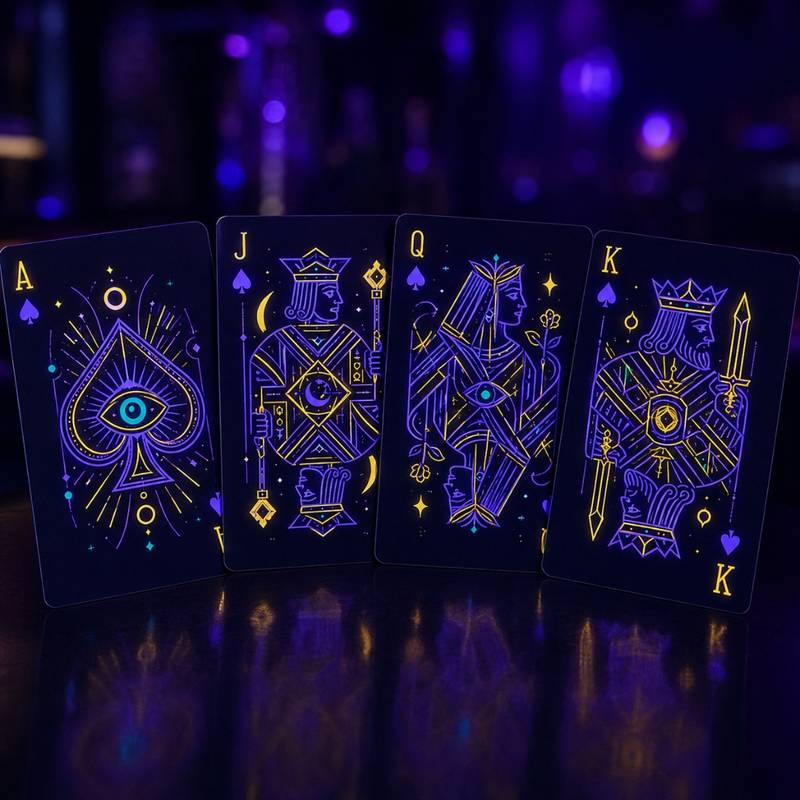
Specialty playing card printing cost breaks into distinct line items. The base production expense reflects card stock grade, deck quantity, and sheet layout. UV coating adds a protective layer that resists scuffing through 1,000 or more shuffles. Customization choices drive the next tier of spending. Foil stamping, embossing, and bespoke tuck boxes each carry separate tooling and application fees. A manufacturer offering free design consultation absorbs pre-press file adjustments that other suppliers bill hourly.
Get a Custom UV-Reactive Playing Card Quote from WellCards
Does UV coating affect the per-deck price?
UV coating increases the per-unit cost modestly. The finish extends deck lifespan and eliminates the need for lamination on standard paper stocks. For tabletop designers shipping Kickstarter rewards, that durability prevents replacement requests and negative reviews.
What hidden costs do first-time buyers miss?
Freight and sampling represent the two most common budget gaps. International shipping to over 200 countries via DHL, FedEx, and UPS fluctuates with fuel surcharges and carton dimensions. Physical samples delivered within seven days let procurement teams verify finish quality before committing to a full production run. Skipping that step risks a container of decks that feel wrong in hand.
The company serves brands, educators, distributors, and wholesalers across Europe, the United States, and worldwide. Procurement leads who request a line-item quote before artwork is finalized avoid the most expensive surprises.
FAQ
What is the minimum order quantity for custom UV playing cards?
Custom UV playing card MOQs start at 500 decks. WellCards offers this threshold for Kickstarter creators and tabletop designers.
What factors drive the per-deck cost?
Material selection, order volume, and finishing complexity drive costs. Paper stock costs less than PVC, and larger volumes reduce per-deck price by spreading fixed setup costs.
How does the factory-direct model affect pricing?
WellCards operates directly from Lanxi, Zhejiang, China, saving buyers 30–50% compared to intermediary channels. This margin widens further on bulk orders.
Conclusion
A procurement manager who accounts for material grade, finishing complexity, and compliance documentation before requesting a quote avoids the budget gaps that derail production timelines. The cost breakdown confirms that UV coating, structural modifications, and supplier quality infrastructure each carry distinct price implications. Evaluating these factors against the deck’s intended use cycle, rather than defaulting to every available option, keeps per-unit costs predictable and prevents expensive reprints or customs delays.
 English
 Deutsch
 Français
 Polski
 Português do Brasil
 Español
 日本語
 Русский
 العربية
 Italiano
 Nederlands
 Türkçe
 한국어