
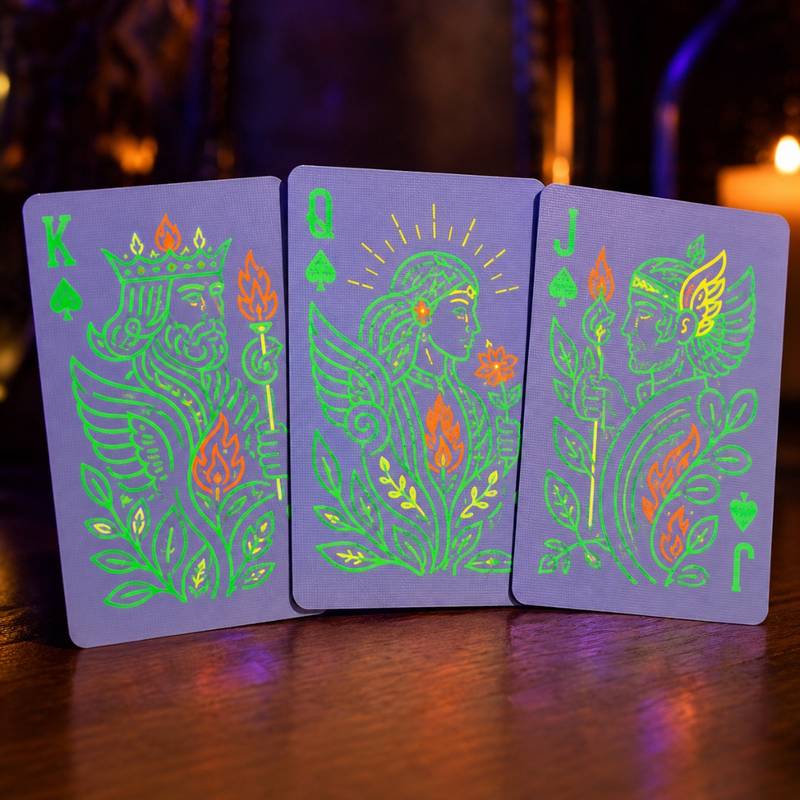
UV-reactive playing cards command premium Kickstarter pledges through exclusive finishes like glow-in-the-dark inks and metal plate add-ons. WellCards, a manufacturer since 1990, produces these specialty decks with certified durability exceeding 1,000 shuffles. Factory-direct pricing saves creators a significant amount compared to domestic printers, with samples delivered in seven days and bulk orders within two to four weeks.
Get a Custom UV-Reactive Playing Card Quote from WellCards
Why are UV-reactive cards trending on Kickstarter?
UV-reactive playing cards deliver a dual-visual experience that standard decks cannot match. Hidden inks and intricate foiling transform the artwork under ultraviolet light, revealing a bioluminescent world that stays invisible in normal lighting. Backers pay for that reveal.
The trend reflects a shift in what Kickstarter playing card ideas must accomplish. A deck that looks identical in every lighting condition offers one product. A deck with hidden artwork offers two. That second layer drives engagement, shares, and pledge momentum.
What makes UV-reactive finishes worth the premium?
The economics favor creators who bundle premium add-ons. One Kraken Abyss campaign tier carries a retail price of US$89, including a UV-reactive collector box and a glowing metal plate. Standard decks rarely command that pledge level. The hidden-ink feature justifies the markup.
WellCards supports this production path directly. The company offers premium paper or PVC material options for custom decks. Creators can specify UV-reactive finishes alongside cold foil and 3D embossing. The result is artwork that changes depending on lighting conditions.
How do UV-reactive cards differentiate a crowded campaign?
Differentiation is the core problem for tabletop creators. Thousands of decks launch each year. A deck with cold foil, 3D embossing, and specialized UV-reactive ink stands apart immediately. The lighting-dependent artwork gives backers a reason to film unboxing videos and share photos under black light.
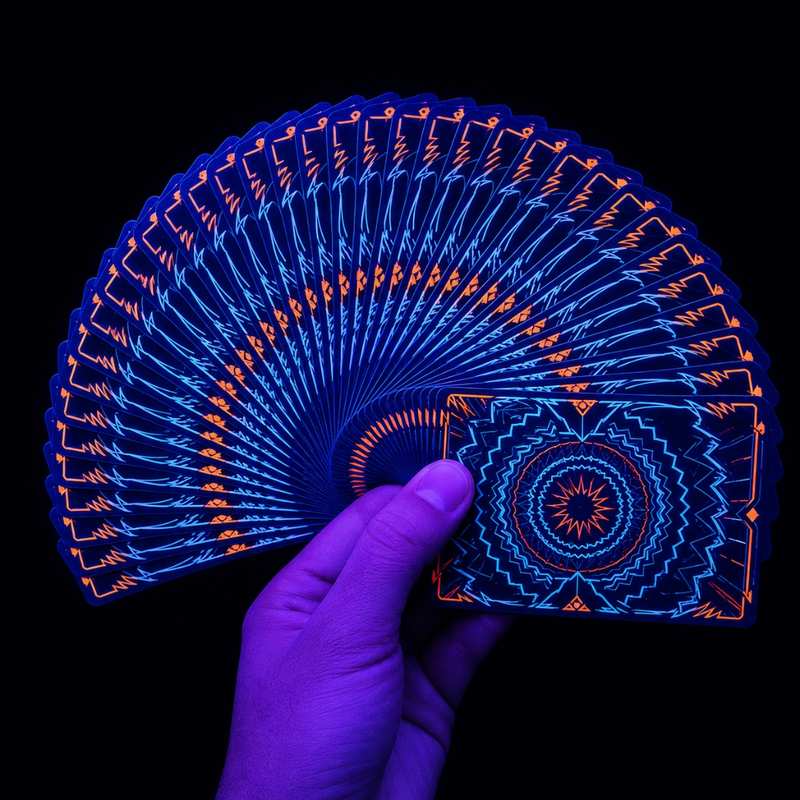
That organic content loop is the real asset. Creators who skip UV-reactive finishes lose the second reveal moment. They lose the shareable proof that the deck exceeds expectations. Custom cyberpunk playing cards benefit most from this effect, since neon circuitry and digital aesthetics read dramatically under UV light.
What makes a UV deck campaign fund successfully?
UV deck campaigns fund successfully when creators present tiered reward structures backed by verifiable manufacturing specifications. The most funded Kickstarter playing card ideas bundle multiple decks, exclusive packaging, and tangible add-ons into a single pledge tier. This approach transforms a single-deck purchase into a collector’s proposition. Perceived value climbs sharply. The Kraken Abyss UV-Reactive Playing Cards campaign, tracked by Kickstarter, structured its featured reward to include an Abyss Deck, Atlas Deck, Abyss Eyes Collector Box, Judgement Eye Glowing Metal Coin, and Ace of Abyss Glowing Metal Plate. Bundling components multiplies the average pledge amount without proportionally increasing production complexity.
Confidence in the manufacturer separates fully funded campaigns from those that stall. Creators working with WellCards receive digital proofs within 24 to 48 hours and physical prototypes credited back to the final order. Prototypes let backers see what they are pledging toward. Uncertainty evaporates.
Why do physical prototypes matter for UV card campaigns?
Backers evaluate tactile quality before committing funds. A physical sample answers questions about stock weight, shuffle feel, and UV ink visibility that renders cannot convey. WellCards delivers physical prototypes as a standard service, removing a friction point that causes hesitation in the funding window.
How does manufacturing support determine campaign success?
UV ink printing demands precise technical specifications. General print shops lack the equipment to register reactive coatings consistently across a full deck run. Custom cyberpunk playing cards with intricate circuit patterns and neon accents require OEM design support to specify correct finishes. WellCards provides full OEM/ODM design consultation, guiding creators through material selection and coating requirements before production begins.
Global distribution capability widens the backer pool substantially. Campaigns that restrict fulfillment to a handful of regions leave funding on the table. WellCards ships completed orders via DHL, FedEx, and UPS to over 200 countries with complete compliance documentation. International backers pledge when tracking, duties, and delivery timelines are transparent from the campaign page.
How do custom cyberpunk playing cards fit this niche?
Custom cyberpunk playing cards align with UV-reactive finishes because the genre’s neon-and-circuit aesthetic intensifies dramatically under black light. A deck inspired by a digital world of vibrant light and circuitry transforms into something entirely different when hidden inks activate. The Kickstarter playing card ideas that succeed in this space lean into that duality: a clean daytime design that erupts into color under UV.
The GRID 2.0 campaign by 4PM DESIGNS proved the model. That project delivered 56 fully custom cards printed on Bee paper stock with UV ink, attracting backers who wanted a collectible object, not just a deck. Custom cyberpunk playing cards with this finish command attention in crowded campaign categories because the before-and-after reveal photographs well and generates social sharing.
Get a Custom UV-Reactive Playing Card Quote from WellCards
What production features make cyberpunk decks stand out?
WellCards provides foiling, embossing, and custom sizing, each of which amplifies a futuristic visual theme. Metallic foil on circuit patterns catches light even without UV. Embossed textures add a tactile dimension that photographs poorly but delights backers upon unboxing. These details separate a premium cyberpunk deck from a standard printed novelty.
How does manufacturing cost affect campaign viability?
Factory-direct pricing from WellCards reduces production costs significantly compared to domestic printers. That margin lets creators offer higher-specification cyberpunk decks at pledge levels backers accept. A campaign that absorbs domestic printing costs often compromises on stock or finish. The alternative preserves both quality and funding goals.
For projects that push beyond standard dimensions, the company’s experience with non-standard playing cards ensures the final product matches the prototype. Creators avoid the disappointment of a design that worked on screen but failed in production.
What production specs matter most for UV decks?
Durability and compliance define a UV-reactive deck’s viability. A deck that delaminates after 500 shuffles destroys a Kickstarter campaign’s reputation. WellCards guarantees 1,000+ shuffles per deck, ensuring the finish and hidden ink layers withstand repeated handling by collectors and players.
Why does ink registration fail on UV decks?
Misaligned UV ink layers ruin the reveal effect. The hidden artwork becomes a smeared ghost of its intended design. WellCards employs triple-check quality control across pre-press, printing, and final inspection. This process catches registration errors before a single deck ships. For creators investing in complex custom cyberpunk playing cards with intricate circuitry patterns, that precision is non-negotiable.
What certifications do backers actually check?
European and American backers increasingly verify safety documentation before pledging. A campaign without proper certifications faces customs holds and refund requests. WellCards maintains FSC, REACH, and EN71 compliance, covering the full regulatory spectrum for global fulfillment. These certifications confirm the inks and substrates meet strict chemical safety standards. Campaigns shipping to 200+ countries avoid the logistical nightmare of rejected shipments at border checkpoints.
Production scale matters equally. A campaign that funds 10,000 decks needs a manufacturer that treats that volume as routine, not exceptional. WellCards operates with a monthly capacity of 1M+ decks. That throughput absorbs large Kickstarter playing card ideas without cascading delays. Creators who skip production error prevention during the proofing phase risk discovering alignment flaws only after backers receive their rewards. The triple-check system eliminates that exposure.
How can creators validate their UV deck concept?
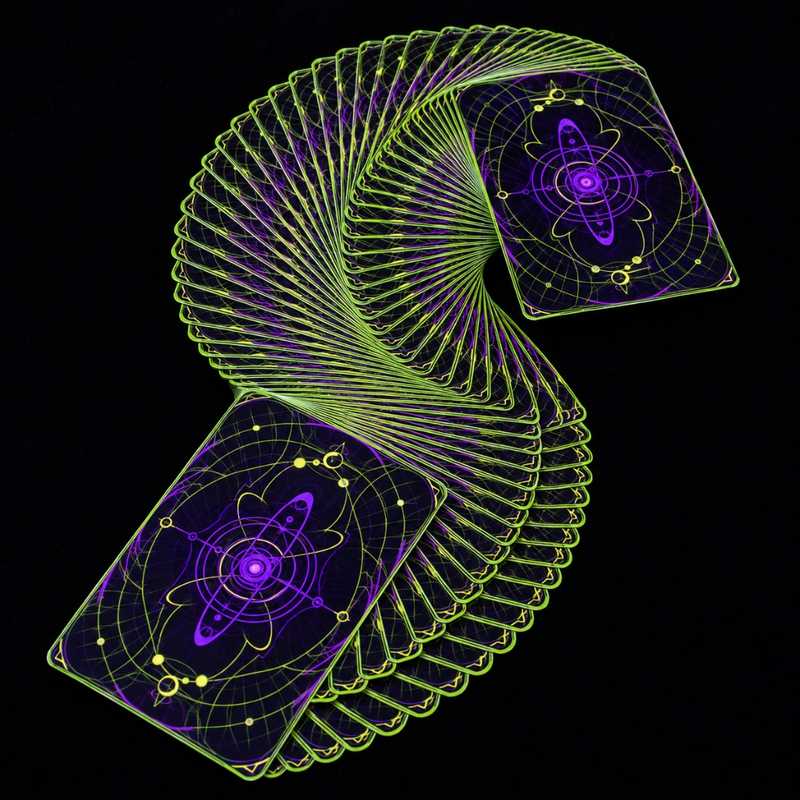
Validation requires physical proof, not digital mockups. A UV-reactive design that looks brilliant on screen often disappoints under actual black light. Creators who skip prototyping risk funding a campaign with artwork that fails to deliver the promised glow effect.
Kickstarter playing card ideas succeed or fail on visual evidence. Backers need to see the transformation. WellCards provides free design consultation and digital proofs within 24 to 48 hours. This rapid turnaround lets creators test UV-reactive artwork before committing to full production. Adjustments happen early, not after manufacturing begins.
Get a Custom UV-Reactive Playing Card Quote from WellCards
What physical proof do creators need before launching?
Physical prototypes reveal what screens hide. WellCards ships sample decks in seven days. A tangible deck under black light shows the true opacity of UV ink and the quality of foil application. Creators photograph these samples for campaign pages and social media promotion. Nothing converts backers like real product photography.
How can indie designers test niche themes without large inventory risk?
Small-batch production eliminates the inventory gamble. Flexible MOQs starting at 500 decks let creators test concepts like custom cyberpunk playing cards without overcommitting. A designer can run a focused Kickstarter, prove demand, and scale only after funding succeeds. The math is straightforward: 500 decks validate a concept; 5,000 decks fulfill proven demand.
Prototype costs disappear from the final budget. WellCards credits physical prototypes back to the order. Creators inspect UV ink performance and foil quality under black light before their campaign goes live. The prototype becomes a zero-cost insurance policy against disappointing backers with subpar glow effects.
FAQ
Why are UV-reactive playing cards trending on Kickstarter?
UV-reactive cards reveal hidden artwork under ultraviolet light, creating a second visual experience that standard decks lack. This dual-layer design drives engagement, shares, and pledge momentum.
What makes UV-reactive finishes worth the premium price?
The hidden-ink feature justifies higher pledge tiers, like the US$89 Kraken Abyss campaign with a collector box and glowing metal plate. WellCards supports this with UV-reactive finishes alongside cold foil and 3D embossing.
How do physical prototypes help UV card campaigns fund?
WellCards delivers physical prototypes credited back to the final order, letting backers see the actual deck. This removes uncertainty and builds confidence in the manufacturer, separating funded campaigns from stalled ones.
Conclusion
A creator who validates UV ink registration, durability, and compliance through physical prototypes before launch eliminates the risk of a campaign that fails to deliver its promised glow effect. The decision to secure factory-direct pricing, triple-check quality control, and certified materials determines whether a Kickstarter project funds successfully or stalls under backer disappointment.
 English
 Deutsch
 Français
 Polski
 Português do Brasil
 Español
 日本語
 Русский
 العربية
 Italiano
 Nederlands
 Türkçe
 한국어