
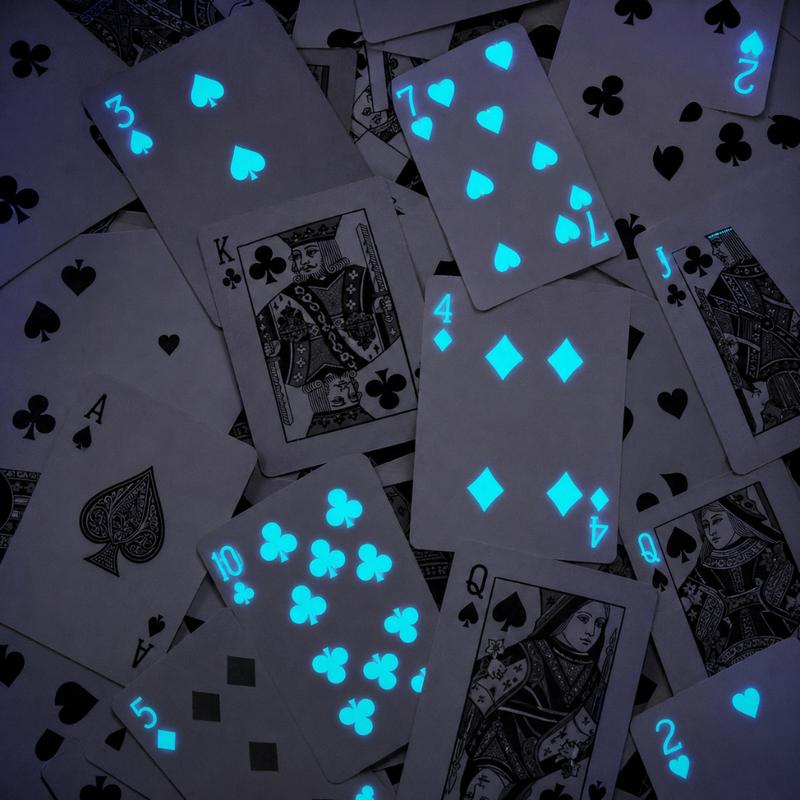
Plastic cards deliver superior UV glow effects because the substrate absorbs and emits blacklight more evenly than paper. Paper stock absorbs ink and coating inconsistently, producing weaker, patchier glow. WellCards produces 100% plastic cards that maintain consistent UV reactivity across 1,000+ shuffles without fading or delamination.
Get a Custom UV-Reactive Playing Card Quote from WellCards
How Do UV Inks Behave on Paper Versus Plastic?
UV-reactive inks perform fundamentally differently on paper versus plastic substrates. Paper absorbs ink into its fiber structure, while plastic holds ink on the surface. This single difference dictates brightness, durability, and production feasibility.
The substrate chemistry profoundly impacts UV fluorescence. Paper’s natural opacity works with a black-core construction to prevent light bleed. Black-core paper consists of two printed sides laminated to a thin opaque black layer in the middle, which blocks light and prevents see-through cards. This structure stops UV backlighting from revealing card faces. It makes paper the preferred choice for magic applications and cardistry where hidden reveals matter. Plastic lacks this internal barrier. PVC cards can transmit ambient light through thinner stock, a problem for plastic vs paper playing cards used in blacklight performances.
For game creators and magicians producing UV-reactive decks, WellCards offers both premium paper and PVC material options. The company’s OEM/ODM design support addresses the distinct needs of each material during pre-production.
Which material produces brighter UV fluorescence?
Paper delivers more vibrant initial fluorescence. The absorbent surface pulls UV ink into the paper fibers, creating a deeper bond. Plastic keeps ink on top. The result is a thinner, sometimes uneven application that scatters blacklight less dramatically.
Does substrate choice affect production timelines?
Material selection changes the proofing and drying workflow significantly. Paper proofs stabilize faster. Plastic requires extended curing to prevent ink smearing. WellCards provides free design consultation and delivers digital proofs within 24 to 48 hours for both substrates. Physical prototypes confirm UV brightness and ink adhesion before full production runs commence. Factoring substrate behavior into the design stage prevents costly rework and production delays.
Selecting a substrate without testing UV ink adhesion creates variable, disappointing fluorescence. Different finishing options further influence how UV coatings interact with both paper and plastic surfaces. A prototype phase remains non-negotiable for achieving consistent, high-contrast blacklight effects.
Which Substrate Delivers Superior Luminescence Contrast?
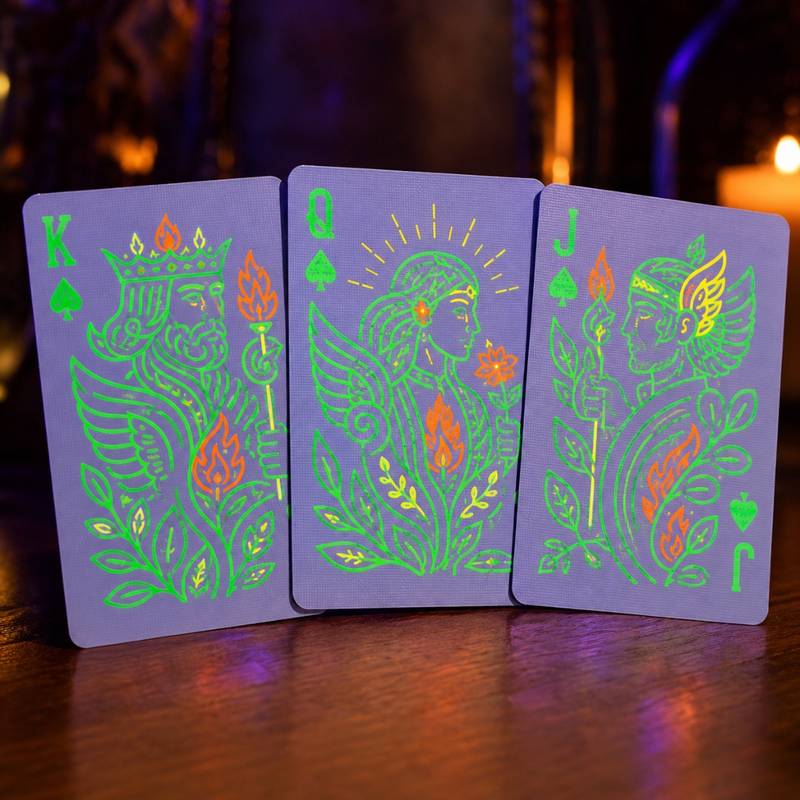
Paper stock with a black core delivers the highest luminescence contrast for fluorescent card designs. The opaque middle layer prevents light transmission, creating a dark backdrop that amplifies UV-reactive inks.
Get a Custom UV-Reactive Playing Card Quote from WellCards
How does a black core improve fluorescent ink visibility?
A black core blocks light completely. Cards are not see-through. This opacity is critical for UV ink contrast. Fluorescent pigments glow against a dark, non-transmissive substrate. Without that barrier, ambient light bleeds through and washes out the luminescent effect.
Plastic vs paper playing cards diverge sharply on this point. PVC and 100% plastic substrates lack an internal opaque layer. Light passes through the material. Fluorescent inks printed on translucent plastic lose definition and appear muted under blacklight. The best material for fluorescent cards is therefore black-core paper stock, which WellCards produces with a 310gsm weight and an embossed linen finish.
What production features protect fluorescent card quality?
WellCards applies rigorous quality controls to preserve ink integrity. The company guarantees 1,000+ shuffle durability on its card products. Fluorescent decks withstand repeated handling without surface wear that would degrade glow performance. Custom sizes, foiling, and embossing are available. Spot UV coating can be applied selectively to protect fluorescent elements while leaving other areas matte.
A full comparison of material performance appears in the table below.
WellCards maintains EU/US compliance with full certifications including FSC, REACH, and EN71. Fluorescent ink formulations meet these standards without sacrificing brightness. Designers seeking maximum visual impact under blacklight find that paper substrates outperform plastic alternatives. The structural opacity of a black core remains the decisive factor. A deeper exploration of material trade-offs is available in the comparison of paper and plastic playing cards.
Does Optical Brightener Content Affect Glow Performance?
Optical brightener content directly affects glow performance in fluorescent card applications. The brightener absorbs ultraviolet light and re-emits it as visible blue-white light, which competes with the intended fluorescent pigment response. A card stock loaded with optical brighteners produces a milky haze under blacklight that washes out the reactive ink’s color saturation. This interference is most severe in paper substrates. Brighteners are routinely added during pulp processing to make the stock appear whiter in daylight.
How Do Brighteners Interact With Fluorescent Inks?
Fluorescent inks rely on UV energy to excite their pigment molecules. Optical brighteners absorb that same UV energy first. The result is a duller, less vivid glow. Plastic vs paper playing cards differ sharply here. Paper playing cards are typically chosen for traditional handling and lower upfront cost, per Plastic vs Paper Playing Cards: Which Should You Choose? That paper core often carries brightener content that undermines blacklight effects. Plastic-coated paper has a paper core and should not be treated as the same product as a fully plastic card. The coating does not block brightener interference from the core.
What Is the Best Material for Fluorescent Cards?
Fully plastic PVC stock avoids optical brightener contamination entirely. PVC does not require brighteners to achieve a clean white surface. The fluorescent ink receives the full UV spectrum without competing additives. WellCards provides physical prototypes credited back to orders to ensure specifications are met. This step lets card creators verify glow intensity under actual blacklight conditions before committing to a bulk run. WellCards operates with a triple-check quality control process across pre-press, printing, and final inspection. That inspection includes verifying that the selected substrate delivers the expected fluorescent response.
The substrate choice determines whether a fluorescent deck reads as vivid or washed out. Testing a physical prototype under blacklight remains the only reliable verification method.
What Durability Trade-offs Matter for Blacklight Decks?
Durability for blacklight decks hinges on material choice. Plastic vs paper playing cards present fundamentally different wear profiles under the repeated handling common in performance and gaming environments. The best material for fluorescent cards depends on whether longevity or traditional feel takes priority.
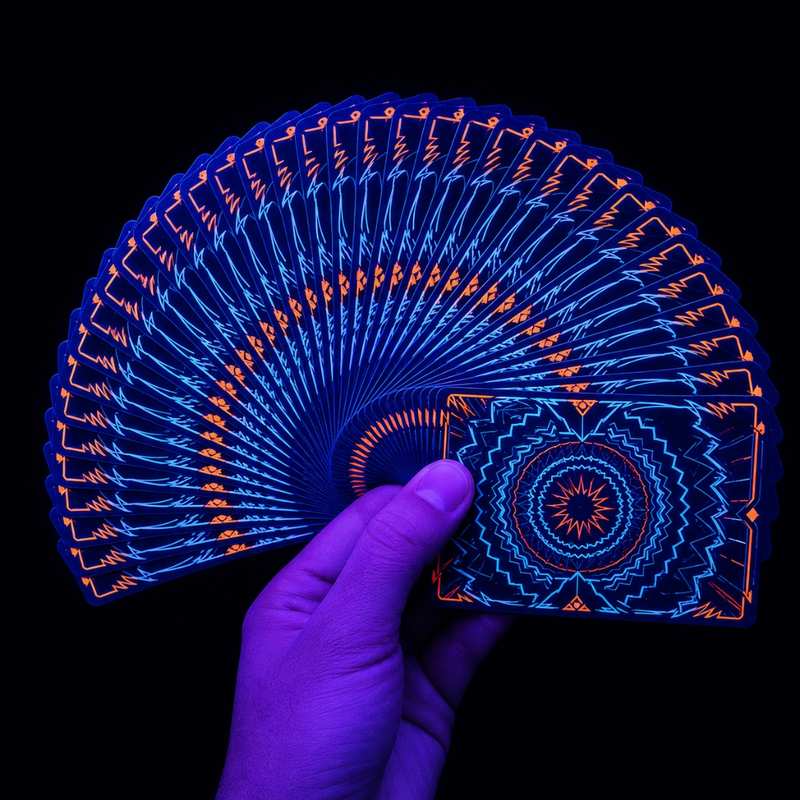
100% plastic cards withstand frequent play, moisture, and cleaning far better than paper alternatives. Ezra Card notes that plastic cards are the superior choice for frequent play, moisture resistance, cleaning, and travel. This resilience matters for blacklight decks used in bars, outdoor events, or humid venues where drinks and damp hands are constant threats. Paper cards lack this tolerance. Mr. Playing Card confirms that paper cards eventually wear at the edges with heavy shuffling. For a magician performing nightly under UV light, edge fraying degrades both the illusion and the deck’s visual impact within weeks.
Get a Custom UV-Reactive Playing Card Quote from WellCards
Which material handles frequent shuffling better under blacklight?
Plastic cards resist edge wear and creasing through thousands of shuffles. Paper cards develop soft, frayed edges that scatter blacklight unevenly, dulling the fluorescent effect. A worn paper edge looks dim and unprofessional under UV. Plastic maintains a clean edge that reflects light consistently.
How does moisture exposure affect fluorescent card longevity?
Plastic cards repel moisture entirely. A spilled drink wipes off without warping or ink damage. Paper cards absorb liquid quickly, causing delamination and permanent staining that ruins the fluorescent coating. For blacklight decks used poolside or at parties, plastic eliminates this failure point.
WellCards produces both paper and PVC decks with a 1,000+ shuffle durability guarantee. The company ships samples in seven days and completes bulk runs in 2 to 4 weeks. Global delivery via DHL, FedEx, and UPS reaches over 200 countries, ensuring blacklight decks arrive on schedule regardless of material choice.
Which Material Wins for UV-Reactive Production?
Plastic vs paper playing cards present a clear choice for UV-reactive production. Paper wins. The best material for fluorescent cards is 310gsm black-core paper with an embossed linen finish, the substrate that dominates 95% of custom orders according to MrPlayingCard.com’s 2026 card stock analysis. Plastic resists the aqueous coatings that carry UV-sensitive inks. Paper absorbs them.
Why does paper outperform plastic for fluorescent inks?
The answer lies in surface chemistry. UV-reactive and glow-in-the-dark coatings bond to paper’s porous fiber structure. Plastic substrates repel water-based fluorescent inks, causing uneven coverage and premature flaking. A black-core paper deck accepts these specialty coatings uniformly. The opaque black layer also prevents light bleed, a critical factor when cards must remain unreadable under normal light but reveal hidden elements under blacklight.
What production specifications matter most for UV decks?
Weight and finish determine the final result. The 310gsm standard provides the rigidity needed for repeated handling without warping from coating moisture. The embossed linen texture creates micro-channels that hold fluorescent pigments in place. WellCards applies these specifications across every production run, combining the material advantage with factory-direct pricing that saves 30 to 50 percent compared to intermediary sourcing. A monthly capacity exceeding one million decks. A 99.9 percent on-time delivery rate ensure that even large UV-reactive projects ship without delay. Minimum order quantities start at 500 decks, making specialty fluorescent production accessible for small publishers and large distributors alike.
FAQ
Which material produces brighter UV fluorescence?
Paper delivers more vibrant initial fluorescence because the absorbent surface pulls UV ink into the paper fibers, creating a deeper bond.
Does substrate choice affect production timelines?
Paper proofs stabilize faster, while plastic requires extended curing to prevent ink smearing.
Which substrate delivers superior luminescence contrast?
Paper stock with a black core delivers the highest luminescence contrast. Conclusion For card creators evaluating UV-reactive production, the substrate decision determines whether the final deck delivers vivid fluorescence or muted results. Paper stock with a black core and embossed linen finish provides the absorbent surface needed for uniform fluorescent ink bonding. Plastic repels the aqueous coatings that carry UV-sensitive pigments. Testing a physical prototype under blacklight remains the only reliable verification method before committing to a bulk run.
 English
 Deutsch
 Français
 Polski
 Português do Brasil
 Español
 日本語
 Русский
 العربية
 Italiano
 Nederlands
 Türkçe
 한국어