
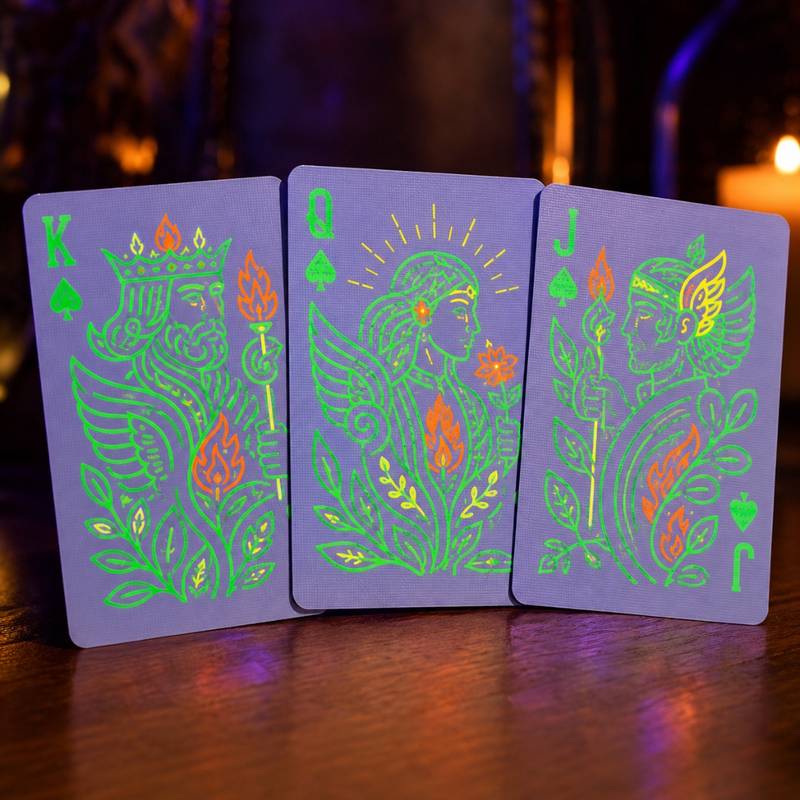
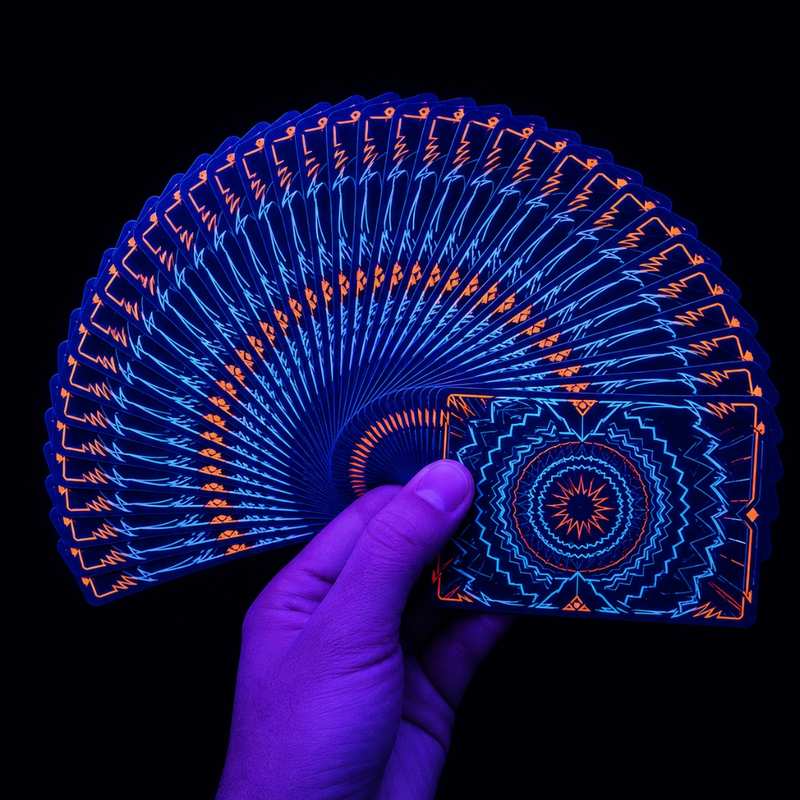
UV-reactive playing card production at WellCards uses a multi-layer ink system combining standard CMYK with fluorescent pigment overlays. These organic compounds absorb ultraviolet radiation and re-emit visible light. Factory-direct manufacturing maintains EU/US compliance with full certifications. Clients receive digital proofs within 24–48 hours, ensuring safety and glow specifications are verified before bulk production.
Get a Custom UV-Reactive Playing Card Quote from WellCards
What makes UV reactive cards safe?
Safety in UV reactive playing cards depends on three factors: ink chemistry, substrate composition, and regulatory compliance. A properly manufactured deck poses no health risk during normal handling and gameplay.
What certifications confirm a UV card deck is non-toxic?
WellCards maintains EU and US compliance with full certifications including FSC, REACH, and EN71 standards. These certifications verify that materials meet strict chemical safety thresholds. Playing card EN71 RoHS certification specifically addresses heavy metals and harmful substances in products intended for repeated skin contact. Procurement managers should request these documents before finalizing any production run.
How does the ink system affect safety?
The non-toxic playing card manufacturing process at WellCards uses a sophisticated multi-layer ink system. This system combines standard CMYK base colors with fluorescent pigment overlays. The fluorescent inks contain organic compounds that absorb ultraviolet radiation and re-emit it as visible light in specific wavelengths. No heavy metals or volatile organic compounds enter the formulation. The result is an eco-friendly UV reactive ink that glows intensely without introducing hazardous chemistry into the supply chain.
What substrate choices reduce risk?
Paper and PVC substrates each carry different safety profiles. WellCards sources FSC-certified paper stock, ensuring responsible forestry and clean processing. PVC options undergo REACH compliance testing for phthalates and stabilizers. The company’s triple-check quality control inspects raw materials at intake, mid-production, and final inspection. This protocol catches contamination before decks reach end users. For tabletop game publishers and Kickstarter creators, specifying certified substrates during the design consultation eliminates compliance surprises during import clearance.
How is eco-friendly UV reactive ink formulated?
Eco-friendly UV reactive ink relies on a multi-layer system that combines standard CMYK base colors with fluorescent pigment overlays. The fluorescent pigments contain organic compounds engineered to absorb ultraviolet radiation and re-emit it as visible light in specific wavelengths. This process creates the intense neon glow effects visible under blacklight conditions. Without this precise chemical formulation, the ink fails to deliver consistent brightness or color accuracy.

Get a Custom UV-Reactive Playing Card Quote from WellCards
What makes UV reactive ink eco-friendly?
The shift toward non-toxic playing card manufacturing demands ink formulations free from heavy metals and volatile organic compounds. Eco-friendly UV reactive ink achieves this by using organic fluorescent compounds that meet strict safety thresholds. These compounds replace traditional solvent-based carriers with 100% solid, solvent-free UV-curable oligomer and monomer systems. The result is a printing process that reduces hazardous emissions without sacrificing the vivid glow required for specialty card decks.
How are custom ink blends developed for specific brand requirements?
Custom ink blends match brand colors while maintaining high UV excitation efficiency for maximum brightness under blacklight. The formulation process follows a structured sequence:
Identify the target brand color under standard lighting conditions.
Select a base CMYK ink that approximates the desired hue.
Integrate fluorescent pigment overlays calibrated to the brand’s specific wavelength requirements.
Test the blend under UV light to verify excitation efficiency and adjust pigment ratios.
Produce a physical prototype for final approval before full production.
WellCards provides free design consultation and digital proofs within 24 to 48 hours. The company’s modern facility in Lanxi supports full OEM and ODM design support, backed by three decades of manufacturing experience. This infrastructure allows procurement managers and Kickstarter creators to iterate quickly on custom formulations.
Does UV reactive ink meet safety certification standards?
Safety compliance is non-negotiable for tabletop game publishers and novelty card creators. The ink formulations align with Playing card EN71 RoHS certification requirements, which govern heavy metal content and chemical migration limits for products handled by consumers. EN71 certification specifically addresses toy safety standards, while RoHS restricts hazardous substances in manufacturing. Cards produced with these certified inks meet EU and US export requirements, eliminating compliance risks for global distribution.
Which certifications verify non-toxic card production?
Three certifications form the backbone of non-toxic playing card manufacturing. Playing card EN71 RoHS certification verifies that cards meet strict European safety standards for heavy metals and chemical migration. FSC chain-of-custody certification confirms that paper stock originates from responsibly managed forests. REACH compliance ensures that no substances of very high concern appear in the finished product.
What does EN71 certification actually test for?
EN71 testing evaluates mechanical hazards, flammability, and chemical composition. The chemical portion specifically measures the migration of 19 heavy elements, including lead, mercury, and cadmium. Cards that pass this standard are safe for skin contact and incidental mouthing. This matters for educational flash cards and any deck handled by children.
How does REACH differ from EN71?
REACH addresses the full chemical lifecycle of a product. It restricts over 200 substances across the entire supply chain, from raw ink pigments to final packaging adhesives. EN71 focuses on the finished article’s safety. REACH digs into every input that went into it. Together, these certifications create overlapping layers of protection.
WellCards maintains EU and US compliance with FSC, REACH, and EN71 standards. The company provides full compliance documentation with every shipment, which ships via DHL, FedEx, and UPS to over 200 countries. Procurement managers should verify these certifications before committing to a production run. A thorough review of what to check before choosing a playing card manufacturer prevents costly compliance failures downstream.
Non-toxic playing card manufacturing also depends on ink chemistry. Eco-friendly UV reactive ink formulations use 100% solid, solvent-free UV-curable oligomer and monomer systems that eliminate volatile organic compounds. The fluorescent pigments themselves are microencapsulated, which prevents direct skin contact with the reactive compounds. This engineering choice maintains the intense glow effect while meeting EN71 migration limits.
Samples ship in seven days. Bulk production completes in two to four weeks. Factory-direct pricing delivers 30 to 50 percent cost savings compared to intermediary suppliers. These operational metrics matter only after the safety certifications are confirmed. Without verified compliance, speed and price offer no real advantage.
How does UV curing ensure skin-safe cards?
UV curing transforms liquid coatings into a solid, inert film in under a second. The process eliminates solvent evaporation, locking all chemical components into a stable polymer matrix that cannot migrate to skin.
Print coatings are very thin, clear protective finishes applied over the top of printed materials. When cured with ultraviolet light, these coatings undergo instantaneous cross-linking. The chemical reaction converts reactive monomers into a fully polymerized solid. No residual solvents remain. No uncured compounds linger on the card surface.
Get a Custom UV-Reactive Playing Card Quote from WellCards
What makes UV-cured coatings different from solvent-based finishes?
Solvent-based coatings dry through evaporation. That process releases volatile organic compounds and leaves microscopic pores in the finish. UV-cured coatings polymerize completely. The resulting film is non-porous and chemically inert. Skin contact triggers no leaching because nothing mobile remains in the coating layer.
How does the triple-check quality system verify coating safety?
WellCards applies rigorous triple-check quality control across pre-press, printing, and final inspection. The first check verifies ink and coating formulations before production begins. The second monitors UV lamp intensity and cure completeness during the print run. The final inspection tests random samples for surface residue and coating integrity. Any deck failing these checks never ships.
This manufacturing discipline supports the company’s 1,000+ shuffle durability guarantee. A fully cured coating resists abrasion without shedding particles. The finish stays intact through repeated handling. For tabletop game publishers and Kickstarter creators, that durability matters. Cards handled by dozens of players at conventions or game nights must remain safe and visually sharp.
The company offers premium paper or PVC material options for custom cards. Both substrates accept UV-cured coatings identically. The polymerization process works independent of the base material, creating the same inert barrier on paper stock or synthetic PVC. Procurement managers sourcing non-toxic playing card manufacturing gain a consistent safety profile across all material choices. Eco-friendly UV reactive ink formulations cure under the same UV lamps, embedding fluorescent pigments within the sealed polymer layer. The resulting glow effects activate under blacklight without exposing users to free pigments or uncured binders. Playing card EN71 RoHS certification confirms this safety through third-party laboratory testing, verifying zero migration of heavy metals or harmful plasticizers from the cured coating.
What should buyers verify before ordering?
Verification of production capabilities and certification documentation prevents costly supply chain failures. A procurement manager who skips this step risks delayed launches, non-compliant inventory, and lost revenue.
What certifications should a manufacturer hold for global distribution?
WellCards maintains Playing card EN71 RoHS certification alongside FSC and REACH compliance. These certifications confirm that materials meet European Union and United States safety standards for heavy metals, phthalates, and mechanical hazards. Without documented EN71 compliance, shipments face customs rejection at EU borders.
How does the prototyping process confirm quality before bulk production?
The company provides physical prototypes credited back to orders. This step allows tabletop game publishers to evaluate card stock, finish, and UV ink performance under actual blacklight conditions. Prototypes reveal registration errors and color shifts that digital proofs miss.
What production scale and lead times should a supplier guarantee?
WellCards operates with a capacity exceeding 1 million decks per month and maintains a high on-time delivery rate. Buyers verify these metrics by requesting production schedules and client references. A supplier unable to document throughput at this scale introduces deadline risk for Kickstarter fulfillment and retail launches.
What minimum order quantities apply to specialty decks?
Flexible MOQs start at 500 decks. This threshold accommodates limited Kickstarter runs and niche novelty releases without forcing excess inventory. Procurement teams confirm MOQ terms in writing before design work begins.
What service structure supports international procurement?
End-to-end production and responsive service cover design consultation, pre-press checks, printing, finishing, and global shipping. Buyers verify that a single point of contact manages the entire workflow. Fragmented communication across multiple vendors increases error rates and extends timelines.
FAQ
What certifications confirm a UV reactive card deck is non-toxic?
EN71 RoHS certification specifically addresses heavy metals and harmful substances in products intended for repeated skin contact.
How does the multi-layer ink system ensure safety?
The system combines standard CMYK base colors with fluorescent pigment overlays containing organic compounds. No heavy metals or volatile organic compounds enter the formulation, creating an eco-friendly UV reactive ink.
What substrate choices reduce safety risk?
WellCards sources FSC-certified paper stock and PVC options undergo REACH compliance testing for phthalates and stabilizers. Triple-check quality control inspects raw materials at intake, mid-production, and final inspection.
Conclusion
For procurement managers, the path to non-toxic UV reactive playing cards requires verifying three documented controls: certified ink formulations, complete UV polymerization, and third-party compliance testing. These elements form the safety foundation that makes glow effects viable for repeated skin contact. Buyers should request certification documentation and production records before committing to bulk orders. Confirmed compliance transforms a visually striking product into a defensible procurement decision, protecting brand reputation and ensuring smooth customs clearance across international markets.
 English
 Deutsch
 Français
 Polski
 Português do Brasil
 Español
 日本語
 Русский
 العربية
 Italiano
 Nederlands
 Türkçe
 한국어