
UV-reactive inks in custom playing cards do fade with prolonged direct sun exposure. WellCards manufactures UV-sensitive decks using premium inks and certified materials, but no fluorescent pigment is permanent under continuous sunlight. Indoor use under standard lighting preserves glow performance for years.

Get a Custom UV-Reactive Playing Card Quote from WellCards
Do UV reactive playing cards fade over time?
UV reactive playing cards fade over time when exposed to ultraviolet light. The degradation is a direct consequence of UV radiation’s capacity to break chemical bonds within the fluorescent inks and card coatings.
Card designers and magicians invest in specialty decks for their visual impact under blacklight. That vibrancy is lost through exposure. Fluorescent playing card fading occurs because ultraviolet light supplies enough energy to sever the molecular bonds in the pigments and the substrate itself. A source from Cardshellz explains the mechanism plainly: UV radiation breaks chemical bonds in the inks, coatings, and cardstock. Once those bonds fracture, the bright fluorescence dims and the card face’s integrity declines.
Why is UV fading so difficult to detect early?
The damage accumulates imperceptibly. Cards appear unchanged for weeks or months while UV exposure continues unchecked. Unlike a crease or a water stain that registers immediately, photochemical breakdown operates below the threshold of visible detection until the cumulative effect becomes obvious.
By the time a collector or performer notices the shift in hue, the UV reactive ink durability has already been compromised. Phantom Display notes that UV degradation unfolds slowly over months and years, in stark contrast to handling wear that is noticed right away. The precise moment of damage remains invisible. What surfaces later is an irreversible loss: colors wash out, whites turn yellow, and the contrast that made the deck pop under blacklight disappears.
What accelerates fading in specialty decks?
Brief, intense exposure does the most harm. A deck left near a window for a single afternoon absorbs substantial UV energy. Repeated display under fluorescent lighting compounds the problem. The deeper issue is that standard paper cards lack inherent UV resistance. Manufacturers apply finishes that improve shuffle feel and handling, but those coatings provide only incidental protection against light damage. Cards designed for performance need deliberate storage protocols. Without them, the deck’s useful life shortens. WellCards engineers its custom playing cards for a 1,000-plus shuffle durability guarantee, prioritizing mechanical resilience. That structural integrity matters, yet physical toughness alone does not shield against photochemical decay. A separate protective strategy, grounded in light discipline, proves necessary to preserve a deck’s reactive brilliance.
Ink chemistry also plays a role. Fluorescent pigments are inherently more fragile than standard offset inks because the very property that makes them glow, their capacity to absorb and re-emit UV energy, renders them vulnerable to the same spectrum. Every blacklight performance contributes microscopic damage. Over dozens of shows, the cumulative effect is measurable.
What causes fluorescent playing card fading?
Fluorescent playing card fading results from ultraviolet radiation breaking chemical bonds in the ink. The damage accumulates invisibly for weeks or months before any visible change appears.
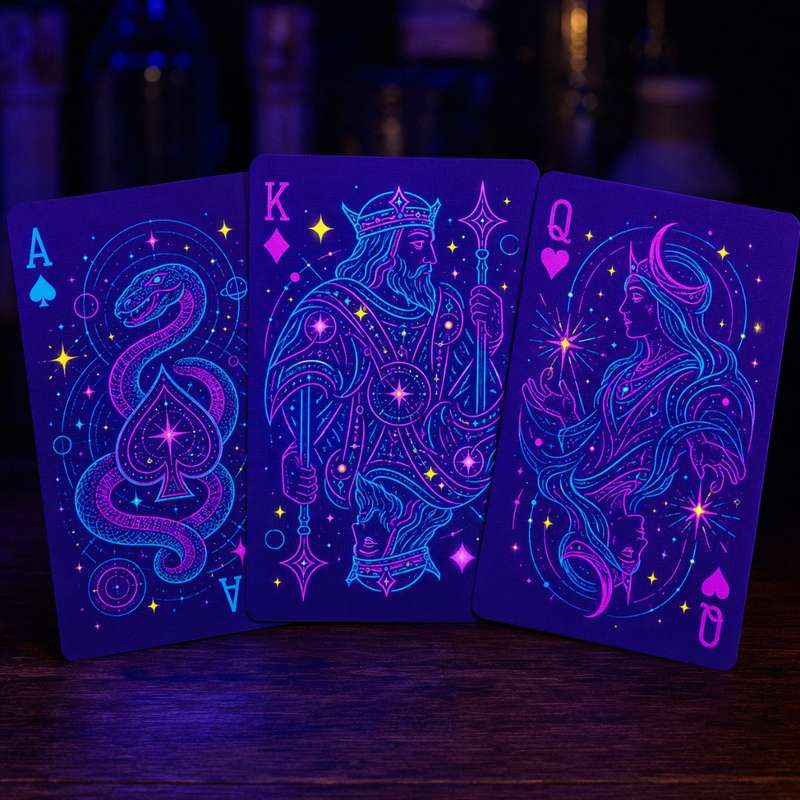
Get a Custom UV-Reactive Playing Card Quote from WellCards
How does UV light reach the cards?
Ultraviolet light is electromagnetic radiation sitting just beyond the visible spectrum. It is present in sunlight, fluorescent bulbs, and even indirect daylight coming through windows, according to Cardshellz. The human eye cannot detect UV radiation. The effects on card surfaces become devastatingly visible over time.
What happens to the ink at a chemical level?
UV radiation carries enough energy to break chemical bonds in the inks, coatings, and cardstock that make up every card. This chemical breakdown is not superficial. It alters the molecular structure of the fluorescent pigments themselves. The vibrant glow that defines fluorescent playing cards diminishes as those bonds fracture. Once the degradation begins, no restoration process reverses it.
UV reactive ink durability depends on three factors:
The pigment’s inherent bond strength against UV photon energy
The protective coating applied over the printed surface
The substrate material absorbing or reflecting residual radiation
Material selection influences degradation rates. WellCards offers premium paper or PVC material options for custom playing cards. PVC substrates provide inherently greater resistance to environmental breakdown than uncoated paper stocks. The substrate acts as the foundation. A stable foundation slows the migration of UV damage into the ink layer above it. Card creators who skip substrate evaluation lose decks to fading that material choice could have prevented.
How does UV reactive ink durability compare across formulations?
UV reactive ink durability varies significantly by formulation and the protective coatings applied over the print layer. No single ink chemistry performs identically under prolonged ultraviolet exposure.
The core vulnerability lies in molecular structure. Cardshellz reports that UV radiation carries enough energy to break chemical bonds in the inks, coatings, and cardstock that make up every trading card. Fluorescent pigments absorb UV energy to emit visible light, which accelerates photodegradation compared to conventional inks. UV reactive ink durability therefore depends on pigment stabilization, binder quality, and whether a UV-blocking overcoat seals the printed surface.
Which formulation factors most affect fluorescent ink longevity?
Three variables determine how long fluorescent inks retain vibrancy. First, pigment particle size influences surface area exposed to radiation. Second, binder chemistry controls how tightly pigment molecules anchor to the cardstock. Third, protective coatings intercept UV photons before they reach the ink layer.
Fluorescent playing card fading follows a predictable pattern. The damage accumulates gradually, then becomes visible only after weeks or months. Cardshellz notes that by the time fading appears, the damage is already permanent. This delayed visibility creates a false sense of security for deck creators evaluating ink samples.
Do protective coatings extend UV reactive ink lifespan?
Coatings provide the most effective defense against photodegradation. Casino-grade cards printed to precise specifications support consistent ink application and durability. Protective coatings and specialized laminate finishes add defensive layers to the card surface, shielding fluorescent pigments from direct UV contact.
The practical implication is straightforward. A fluorescent deck without an overcoat loses vibrancy faster than one with a UV-blocking finish. Formulation choice alone cannot compensate for missing surface protection.
What coatings protect glow intensity in custom decks?
Protective coatings shield UV reactive ink durability by blocking ultraviolet radiation before it degrades the luminescent layer. A clear barrier between the ink and the environment preserves fluorescent playing card fading resistance across thousands of handling cycles.
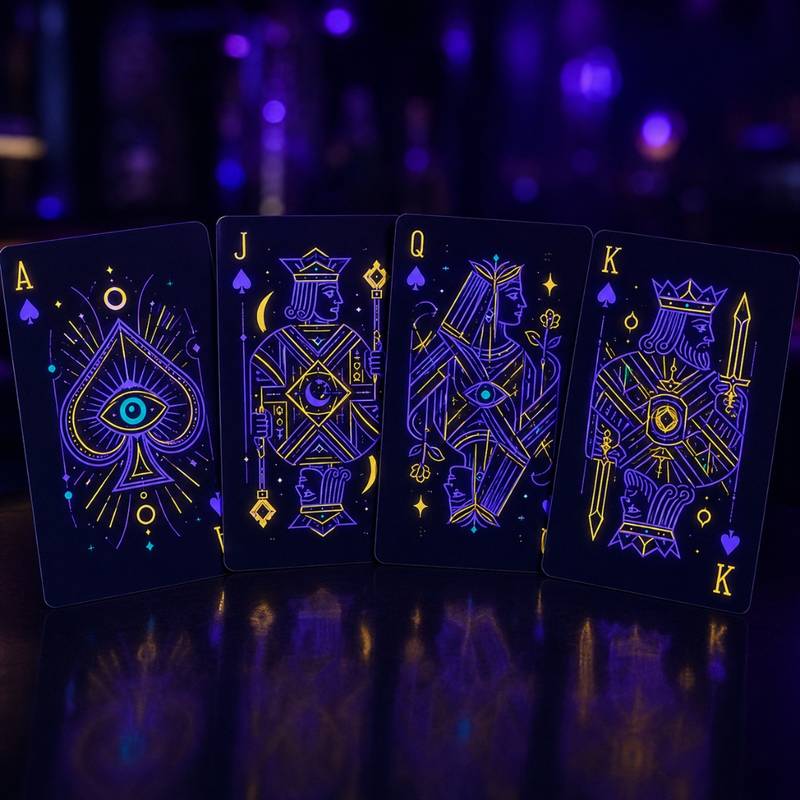
Get a Custom UV-Reactive Playing Card Quote from WellCards
How does UV radiation damage reactive inks?
UV radiation carries enough energy to break chemical bonds in the inks, coatings, and cardstock that make up every card in a collection. The damage accumulates silently. Weeks pass without visible change. Then the glow dims, colors shift, and the deck loses its intended visual impact. A protective coating intercepts this radiation, absorbing or reflecting UV wavelengths before they reach the reactive pigments beneath.
What manufacturing controls ensure coating consistency?
Consistency separates a professional deck from a disappointing one. Uneven coating application creates hot spots where UV penetrates faster, producing patchy glow degradation across the deck. The solution lies in systematic quality control. WellCards applies a rigorous triple-check process across pre-press, printing, and final inspection stages. Each checkpoint verifies coating thickness and uniformity before the batch proceeds further.
Material safety standards reinforce this process. The company maintains EU and US compliance certifications including FSC, REACH, and EN71. These certifications confirm that coating materials meet regulated quality thresholds for durability and user safety.
Can coating performance be tested before bulk production?
Physical prototypes provide the verification mechanism. WellCards supplies prototypes that allow clients to test coating performance under real handling and lighting conditions. The prototype cost credits back to the final order, removing financial friction from the validation step. A deck creator can expose sample cards to UV sources, shuffle them repeatedly, and confirm glow retention before committing to a full production run. This pre-production checkpoint catches coating issues that no digital proof reveals.
How should you store UV reactive cards to prevent fading?
Proper storage blocks ultraviolet light from every source. UV radiation breaks down the chemical bonds in fluorescent inks, causing irreversible color loss and diminished reactivity under blacklight.
Ultraviolet light is not limited to direct sunlight. Cardshellz notes that UV radiation is present in fluorescent bulbs and even indirect daylight coming through windows. A deck left on a desk near a window suffers cumulative damage. The degradation happens gradually over weeks and months, making it especially dangerous because no visible change appears until significant fading has already occurred.
UV reactive ink durability depends entirely on environmental control. Three storage practices prevent premature degradation:
Store decks in opaque, light-blocking containers when not in active use
Position storage units away from windows, skylights, and uncovered fluorescent fixtures
Use UV-filtering display cases only for short-term exhibition, never for long-term storage
Does packaging affect how long UV reactive cards last?
Packaging provides a critical physical barrier. WellCards offers bespoke packaging options that deliver additional protection during storage and transport. A rigid tuck box with a dark interior lining blocks incidental light exposure far better than a standard clear plastic case.
Can durable cards still fade from light exposure?
Mechanical durability does not equal UV resistance. WellCards guarantees 1,000+ shuffle durability on its custom decks, confirming the cardstock and coating withstand extensive handling. However, environmental factors like UV exposure require separate mitigation. A card that survives thousands of riffle shuffles still fades when stored improperly near a light source.
Global shipping introduces additional exposure risks during transit. WellCards ships via DHL, FedEx, and UPS to over 200 countries, with packaging designed to maintain card condition throughout the journey. Fluorescent playing card fading accelerates when decks sit in sorting facilities under harsh overhead lighting, making opaque outer packaging essential from the moment of manufacture.
FAQ
Do UV reactive playing cards fade over time?
UV radiation breaks chemical bonds in the inks, coatings, and cardstock, dimming fluorescence and degrading card integrity.
What accelerates fading in specialty decks?
Brief, intense exposure does the most harm, such as a deck left near a window for an afternoon. Repeated display under fluorescent lighting compounds the damage, and standard paper cards lack inherent UV resistance.
What causes fluorescent playing card fading?
The damage accumulates invisibly for weeks or months before the cumulative effect becomes obvious.
Conclusion
UV reactive playing cards fade when exposed to ultraviolet light, but protective coatings and proper storage prevent that degradation. A deck creator who specifies a UV-blocking overcoat, verifies coating uniformity through physical prototypes, and stores finished decks in opaque packaging eliminates the primary fading risk. The decision to invest in these protections at the manufacturing stage determines whether the deck retains its glow for years or loses it within months.
 English
 Deutsch
 Français
 Polski
 Português do Brasil
 Español
 日本語
 Русский
 العربية
 Italiano
 Nederlands
 Türkçe
 한국어